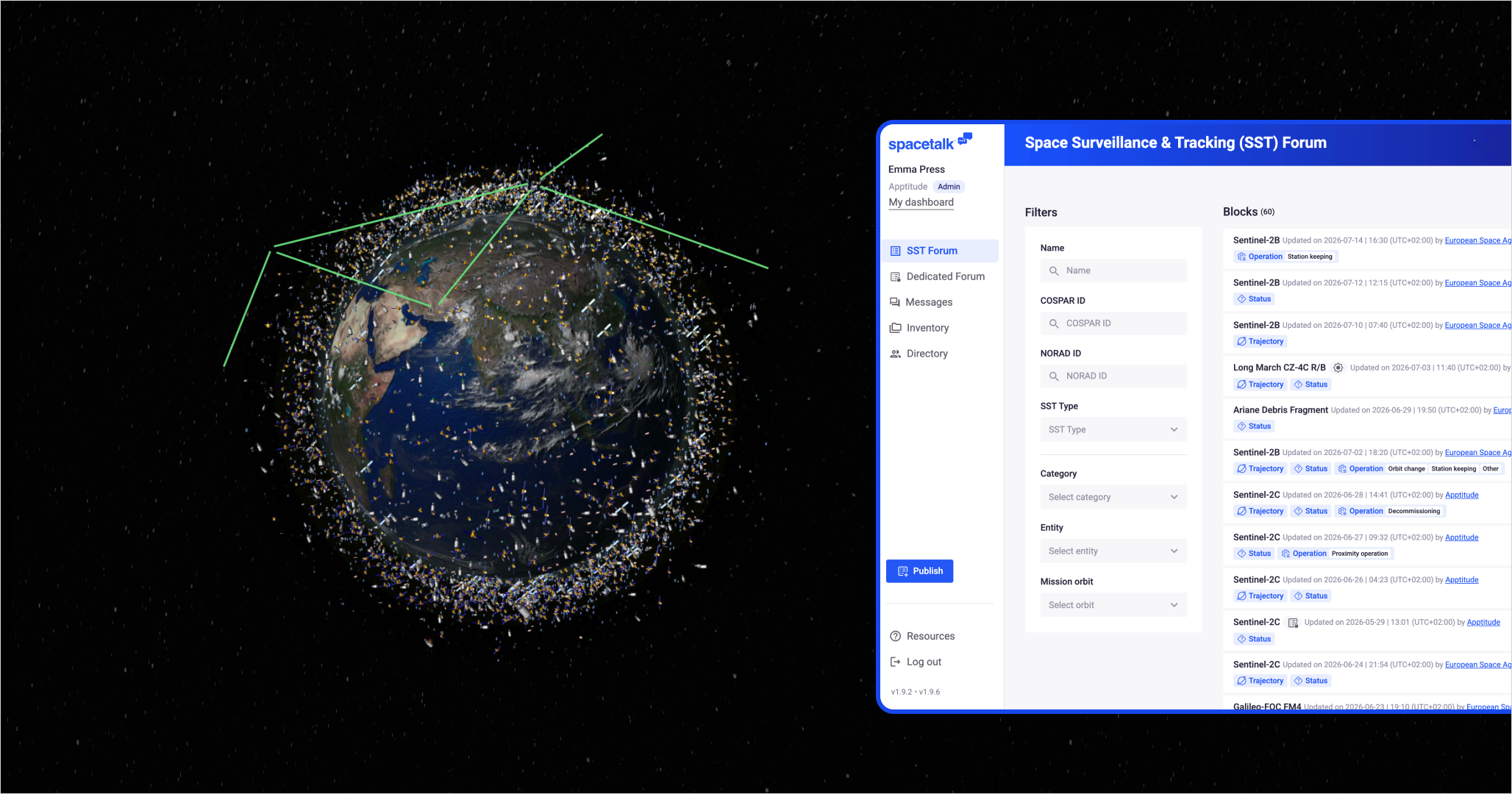
An invisible but critical challenge in space
Today, coordination among the many different stakeholders remains an open challenge. Each produces data according to their own standards and under their own sovereignty constraints. While dialogue does exist between certain operators, a collaborative tool connecting operators from competing space powers is sorely lacking. A sensitive operation like an orbital cleanup can easily be misinterpreted due to the lack of a common channel to describe and validate it among international partners.
To bridge this communication gap, the startup Spacetalk approached Apptitude. The mission: design a platform capable of bringing these stakeholders together, while providing the guarantees of independence and neutrality that the sector demands.
The challenge: enabling communication between stakeholders without a common language
To make shared reading, discussion, and coordination around orbital data possible, the communication challenge is both technical and organizational.
Each organization has its own conventions, confidentiality levels, and ways of describing orbital trajectories. These differences vary depending on countries, civilian or military uses, private operators, or specific fields of activity. A military actor will not have the same approach as a scientist, for example. In practice, each stakeholder “speaks their own language,” even if certain standards exist.
To build a usable product, it was therefore necessary to design an interface capable of structuring information in a unified way to facilitate communication, while also implementing a data conversion engine adapted to technical practices.
This interoperability foundation was what needed to be designed to validate the startup’s concept and what makes everything else possible.
SST blocks: structuring and making critical information interoperable
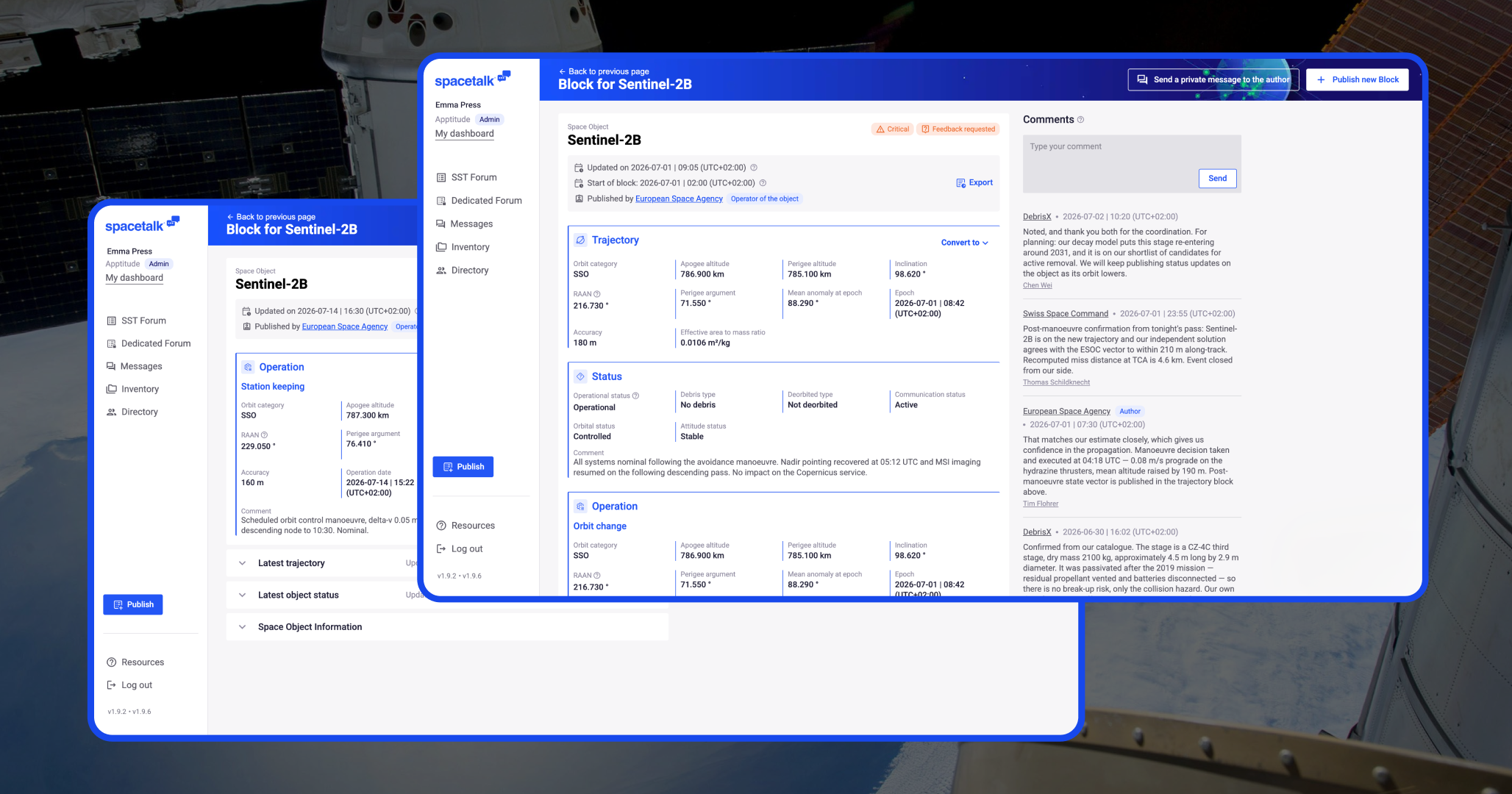
The core of the platform is based on standardized publications called “SST Blocks,” which allow status, trajectory, or operational information about space objects to be shared.
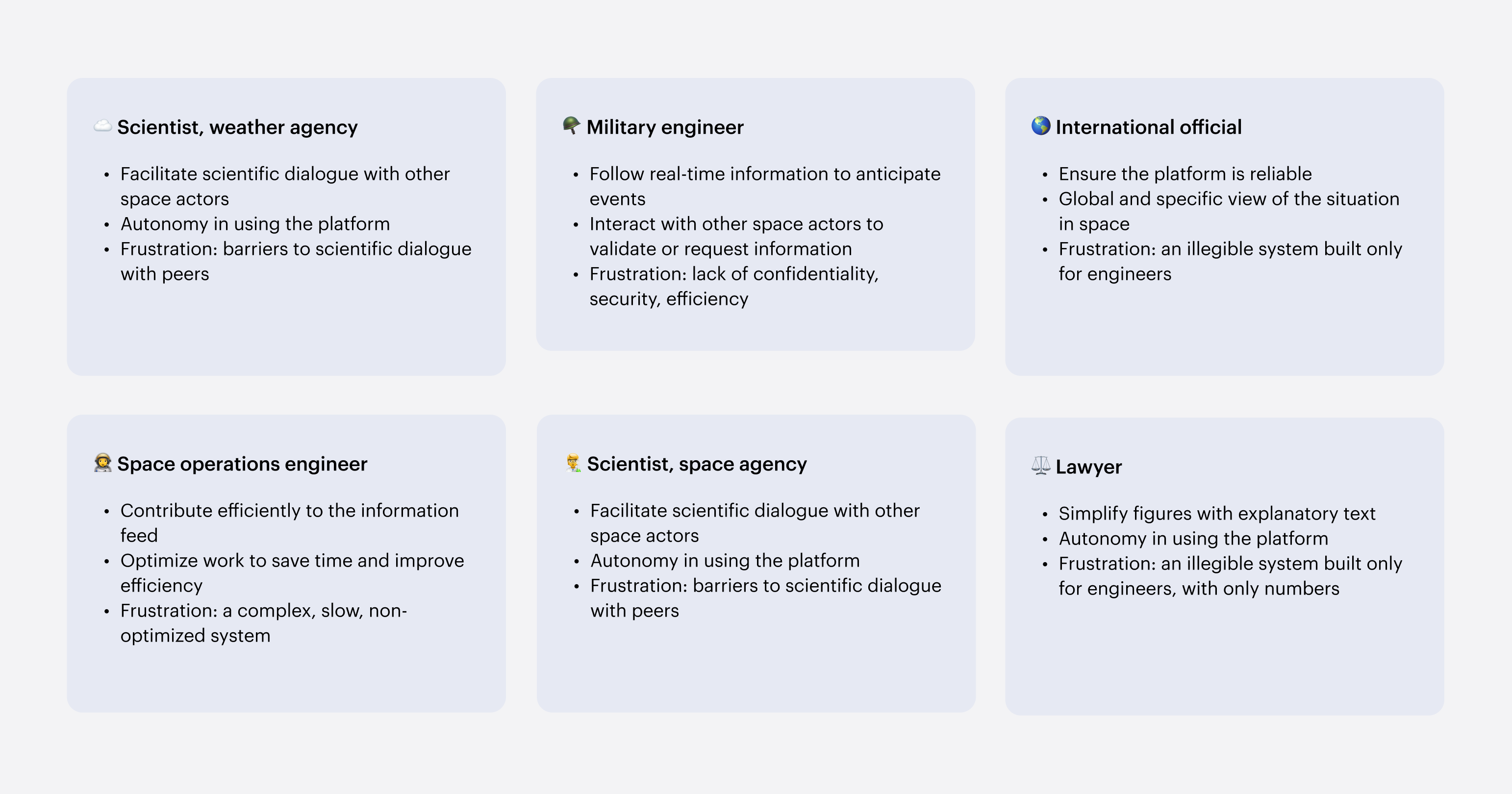
Designing an interface that is readable both for an orbital engineer and for a legal expert
The Spacetalk interface targets a hybrid audience: orbital engineers, operators, but also legal experts, diplomats, military personnel, and insurers. In an international context, the design must be neutral and universal.
This neutrality work is not limited to visual design, but extends to how information is structured and presented. The UX thinking focused on three pillars:
- Information hierarchy: making proximity alerts immediately identifiable.
- Granularity of confidentiality: managing varying levels of visibility depending on mission sensitivity.
- Cultural independence: using a visual language and icons that are unambiguous and understandable to users from all backgrounds.
The dialogue itself varies across regions of the world. With some stakeholders, a scientific approach facilitates exchanges. With others, discussions take place more through private operators or diplomatic channels. The platform therefore had to be designed to adapt to very different cultural and operational contexts.
Designing to convince: the strategic role of the prototype
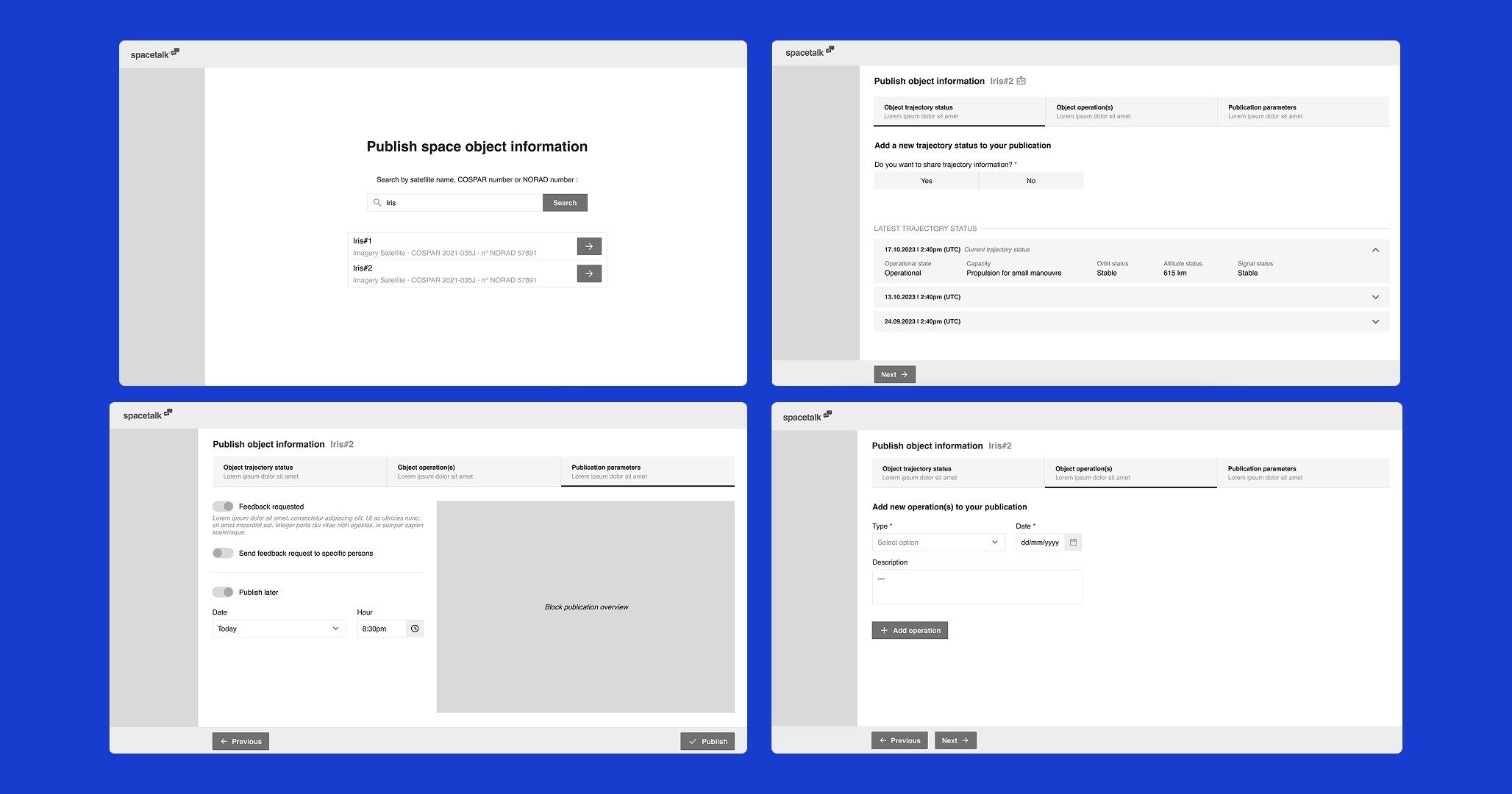
Before entering the development phase, Apptitude’s design team created a clickable prototype, an interactive mockup of the application, which played a decisive role. It made it possible to materialize a complex vision, making it visible and understandable, and facilitated exchanges between Spacetalk and its partners and potential sponsors. In a project of this nature, where challenges are both technical and business-related, making the product tangible was a key step.
The design helped translate ideas into a concrete interface, credible enough to support discussions, gather feedback and insights, and assist in securing funding before moving on to the development of the first version of the application.
This capacity to bring the project to life also eased international discussions with a wide range of stakeholders: space agencies, satellite operators, launch service providers, astronomers, armed forces, scientific partners, as well as financial players like insurers and banks.
Evolving the platform in a dynamic environment
The platform initially focused on an essential foundation: enabling different space actors to publish, consult, and share SST Blocks across more than one million space objects.
In an environment where needs evolve rapidly (new partners, new uses, new geopolitical challenges), the goal was not only to deliver a first functional version. It was above all to design an architecture capable of evolving without questioning the product’s foundations.
Technical choices were therefore made from the outset to support this evolution: decoupled components, fine-grained access management, and a clear separation between data formats and their representation within the platform.
Among these developments, contextualized exchange spaces now allow organizations to discuss published data across multiple confidentiality levels: open, on-demand, or private. This “privacy by design” approach, integrated from the very beginning, made it possible to evolve the product without complicating the user experience or compromising the security of exchanges.
Conclusion: Apptitude’s impact on an early-stage platform
In just a few months, this technical foundation enabled Spacetalk to open discussions with international stakeholders across Europe, China, and the United States, and to enrich the platform with collaborative features without affecting its core architecture.
In an early-stage startup, every week brings new integrations or emerging use cases. Our role was to design an architecture capable of absorbing these demands (composable schemas, extensible data model, separation between input formats and internal representation), so that Spacetalk would never have to choose between meeting a client’s needs and delivering on time.
“We are delighted to have chosen Apptitude as our partner. Their expertise and commitment enabled us to successfully deliver this ambitious project on time and to the highest quality standards. Working with their teams has been a genuine pleasure, and we are pleased that they continue to support us as we grow and develop.”
Benjamin GUYOT – CEO Spacetalk
Among the next steps, the integration of AI capabilities aims to facilitate information discovery within the platform and enhance its multilingual support.
At Apptitude, this is the kind of partnership we love: transforming a structural problem into a robust product right from its first version, built to scale. By reconciling data from a million space objects into a common language, we helped Spacetalk lay the foundations for international coordination that was previously difficult to implement.