The economics of local retail
Evolution of the payment method
According to the Swiss National Bank’s (SNB) 2025 survey, cards account for around half of transactions at points of sale, compared with nearly 30% for cash and around 20% for mobile apps. Contactless payments have become commonplace, while mobile solutions such as TWINT are gradually turning smartphones into digital wallets. Despite this shift, cash remains an important part of everyday payment habits, even though its share has been declining over the years in favour of faster, more integrated payment methods. The SNB therefore observes that payment habits at points of sale changed relatively little between 2024 and 2025, following several years of growth in mobile payments.
What this means for merchants
For retailers, this shift means offering a multichannel payment experience that caters equally to customers who pay in cash and those who prefer contactless card payments or QR codes. These solutions can streamline the checkout process, reduce the handling of cash and make it easier to track transactions. However, they also bring new challenges, including investment in terminals and technical integrations, reliance on connectivity, cybersecurity, data protection and managing transaction fees.
A gradual shift hiding an exponential cost
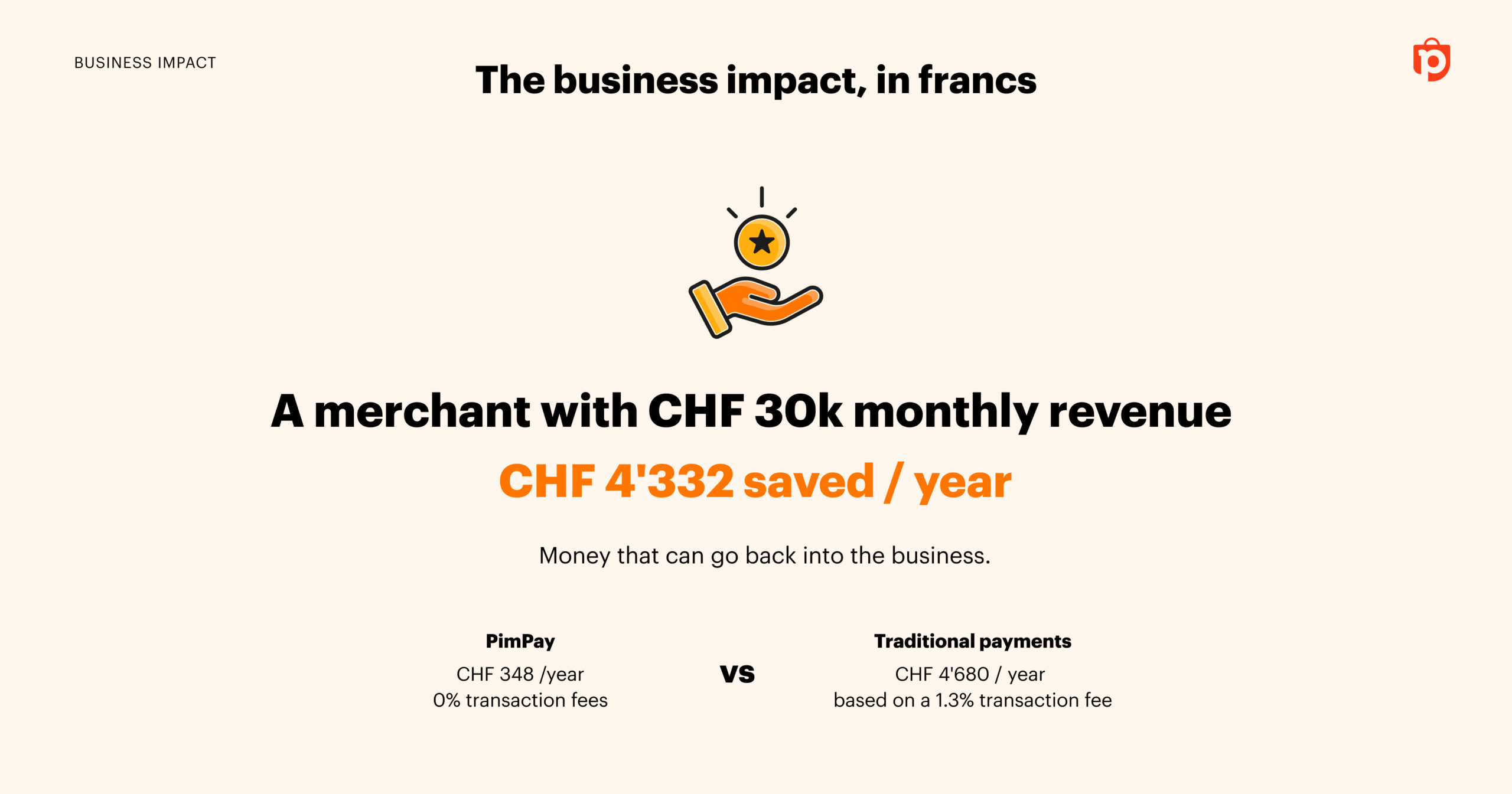
This proliferation of payment methods and the gradual shift towards digital solutions also come with rising costs for retailers. For a bakery, hair salon, grocery shop or local business, each fee charged, combining a minimum fixed cost with a percentage of the transaction, eats into an already pressured margin. In practical terms, a retailer processing CHF 30,000 a month through a payment app would see their costs rise to CHF 390 per month, or CHF 4,680 over a year… solely for this type of payment.
It was against this backdrop that PimPay was created. The ambition was not simply to offer a new payment solution, but to challenge the business model that currently dominates the market.
Disrupting the current market and finally bringing payments and loyalty together
What Business Model?
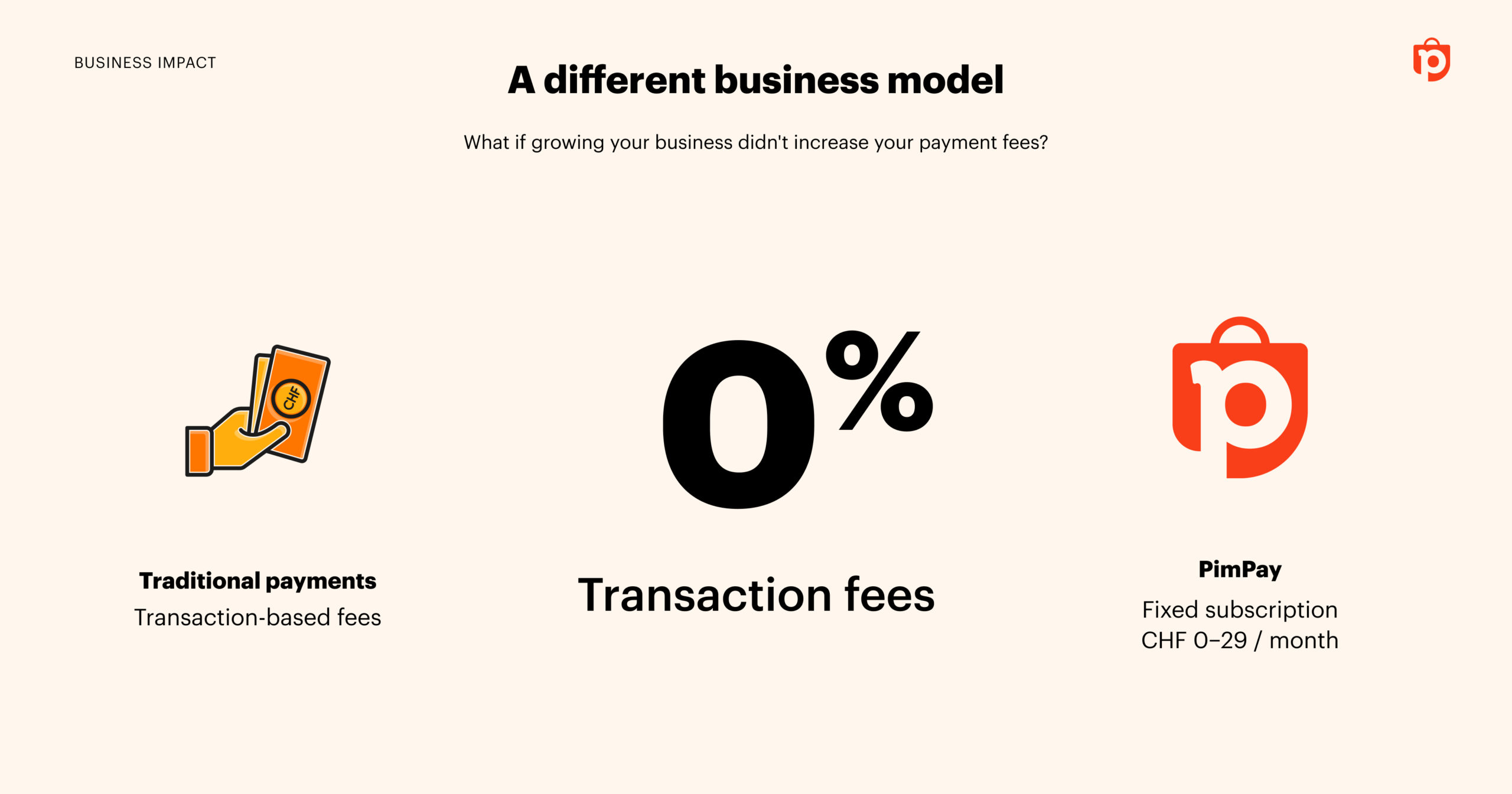
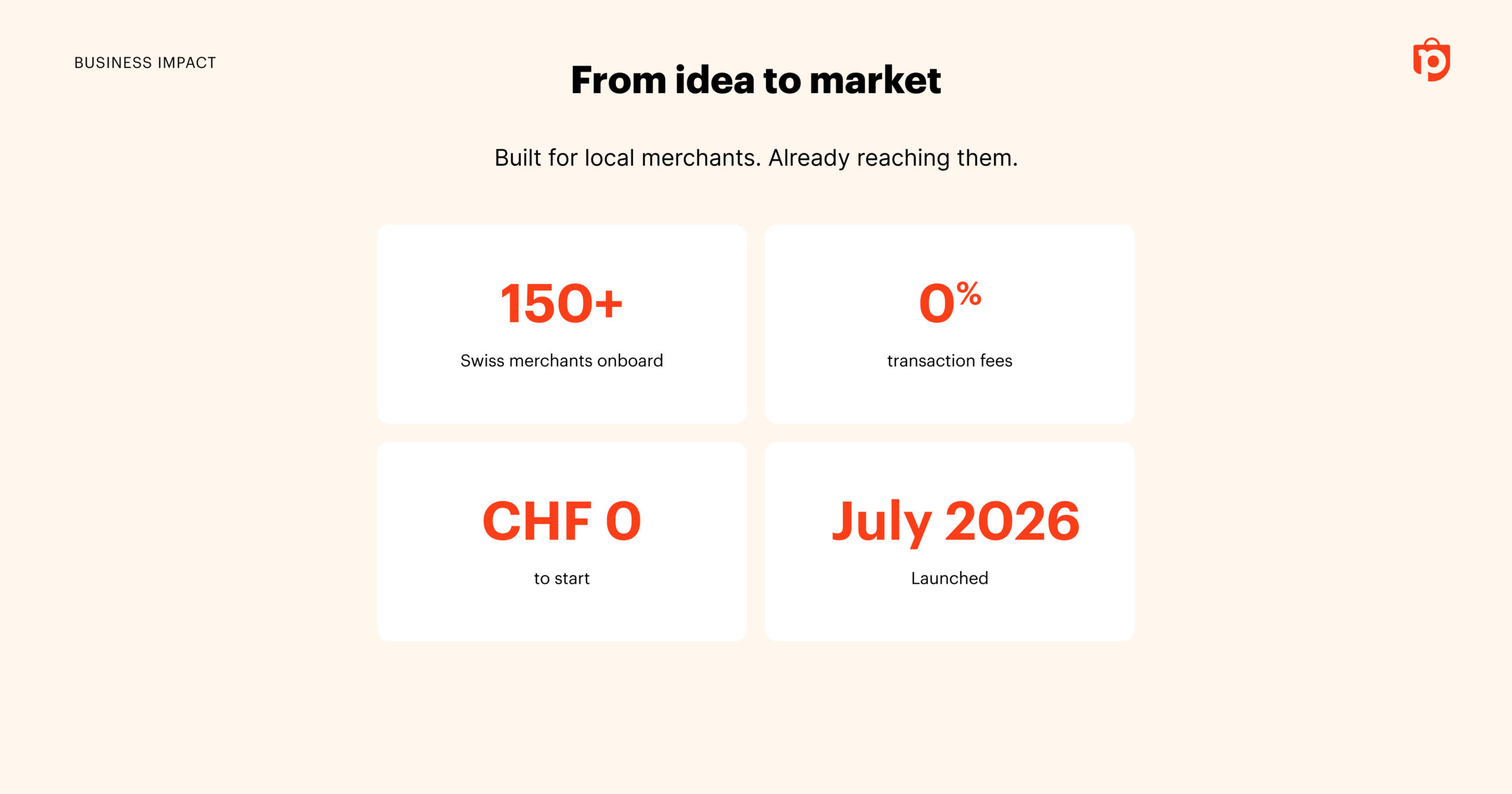
Unlike providers that charge commissions based on transaction volume, PimPay operates on a monthly subscription model. This gives retailers greater visibility over their costs, turning a variable expense into a predictable, budgetable cost with no surprises. But this shift in the business model is only part of the answer. Other challenges and opportunities are still poorly addressed by today’s digital solutions.
To convince retailers and consumers to add a new payment app to their phones, PimPay had to become more than just a way to take payments.
Business impact
Business model
Loyalty as the key
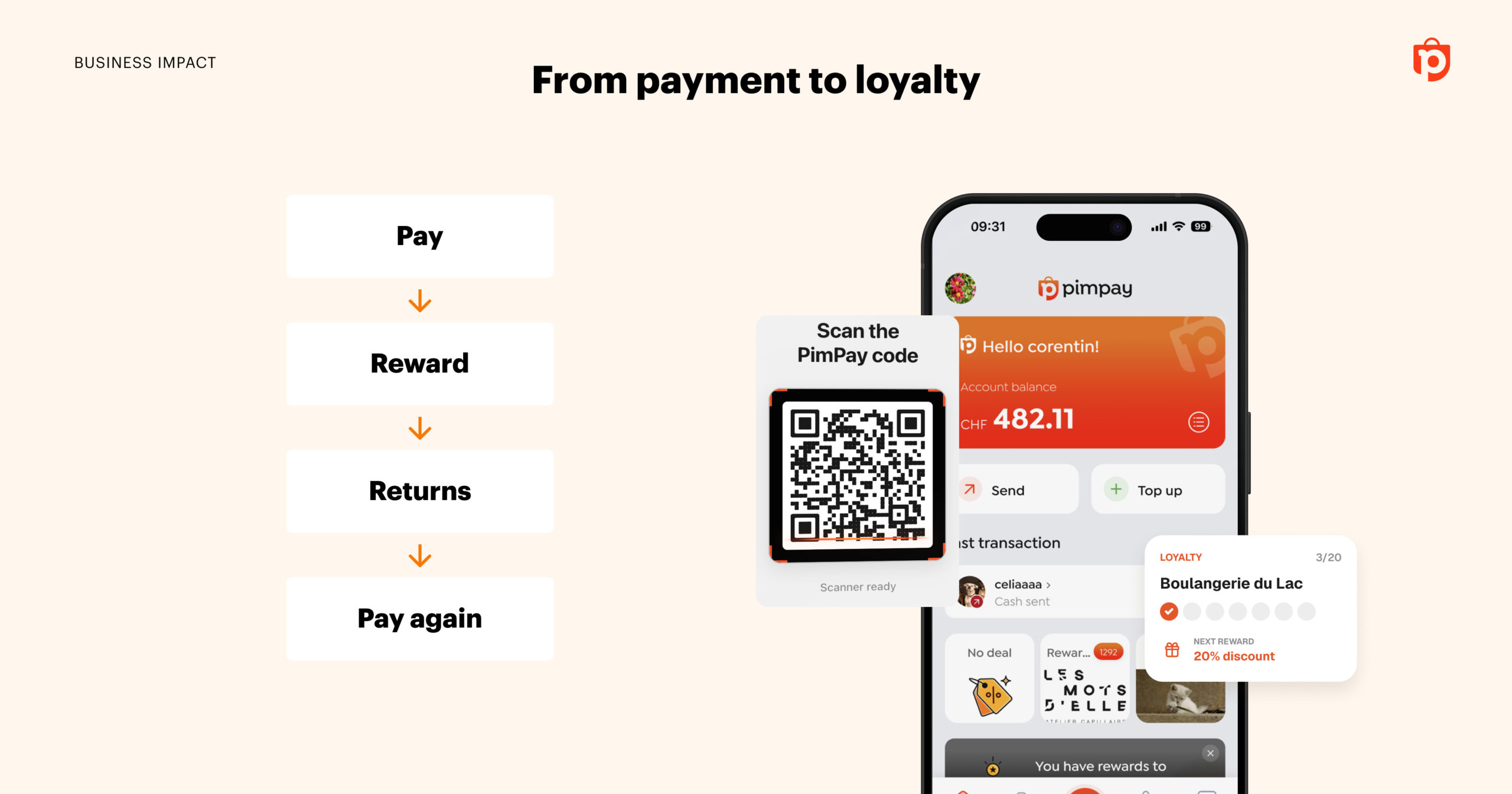
When we think about local businesses such as hairdressers, butchers, florists or bookshops, loyalty quickly comes to mind. Loyalty is essential for these businesses, which generate their revenue from a local or regional customer base of regulars. It also matters to customers, who are rewarded with loyalty points that can occasionally be exchanged for an exclusive discount or a reward after a certain number of visits. The familiar loyalty card, shaped like a credit card and tucked away at the bottom of a wallet, has still not successfully made the transition to digital. Large retailers have their own systems, but the local shopkeeper has often remained with the paper version. By bringing both aspects together, a purchase and a reward, in the same mobile app, PimPay offers a new approach.
And that is not all. When a retailer wants to build customer loyalty, they have another powerful tool at their disposal alongside loyalty points to encourage customers to return: offers, promotions and discounts. The challenge is to communicate these as widely as possible, while still making them targeted. The marketing principle of “the right message, at the right time, to the right person” applies here. PimPay also provides a practical solution by integrating the ability to create local marketing campaigns directly into the app. A retailer can send an offer to app users located around their shop, within a radius calculated according to the population density of the area, and target a specific objective: attracting new customers, increasing visit frequency or raising the average basket value.
Payment becomes the beginning of a relationship, not the end
With this approach, payment is no longer an interchangeable commodity or an act that brings a relationship to an end. Instead, it becomes a genuine commercial lever. Every transaction becomes an opportunity to strengthen customer relationships, increase a business’s visibility and encourage repeat visits.
The retailer is no longer simply paying to process a transaction, but for a tool that also helps grow their business.
Loyalty is the key
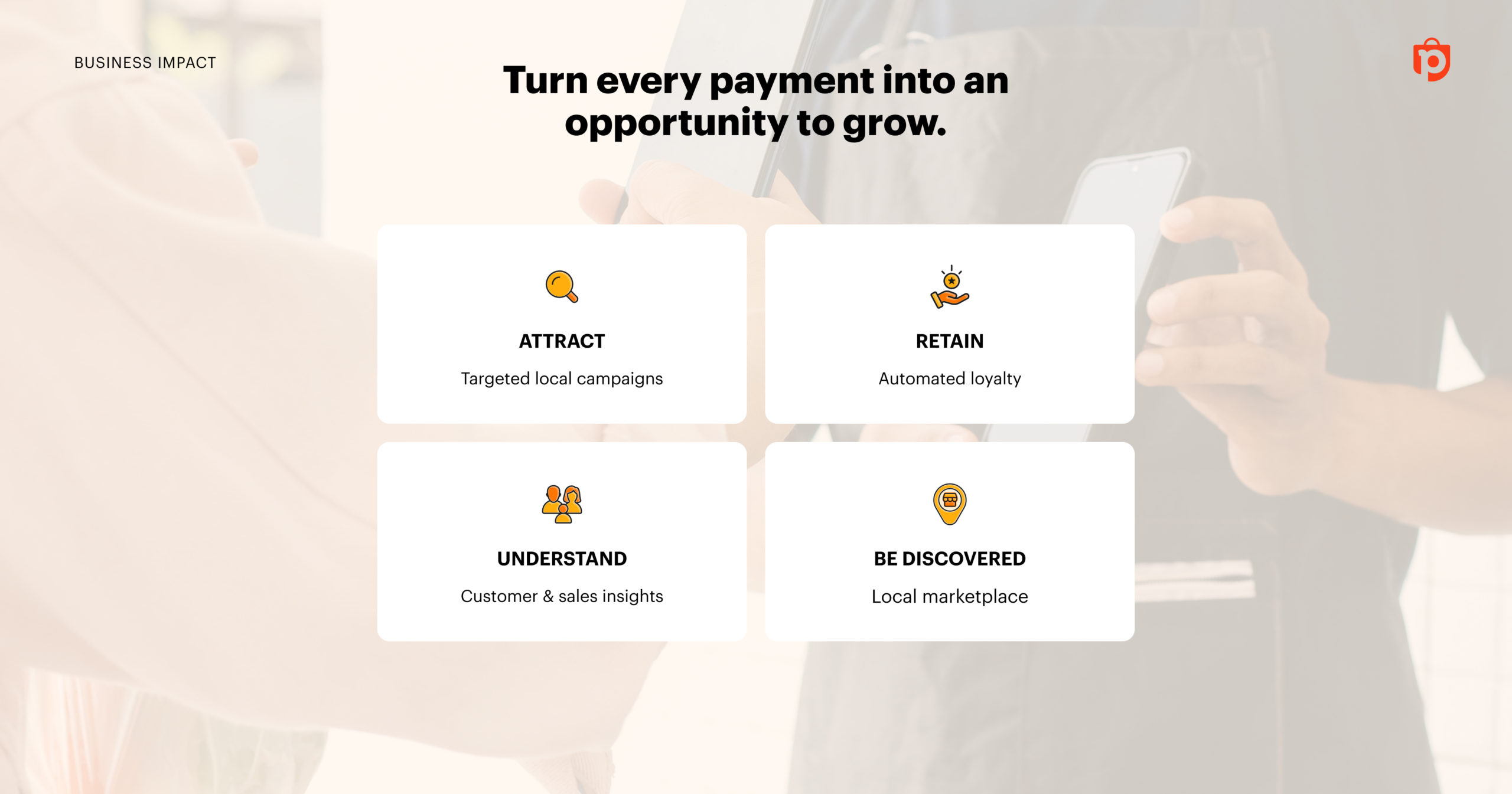
Loyalty is the key
Inspiring trust while staying fast
Apptitude was involved in the design and development of the mobile app, working alongside Arcanite, which was responsible for the backend and transaction logic.
Our goal was to turn a complex fintech infrastructure into a clear, seamless and reassuring experience. Because in a financial product, trust is not built on technical security alone. It is also built through the user experience. And in this case, it is worth remembering that there are two different users, with different needs and interests: a seller and a buyer.
Every screen must make it instantly clear who is paying, who is receiving the money, what amount is involved, where the transaction stands and what actions are available.
The design challenge, tackled by the PimPay team, was therefore to hide the complexity of the system without hiding how it works. Every interaction needed to inspire confidence while remaining fast and intuitive.
QR code and pre-loaded balance
This ambition led to several key design decisions.
The QR code, whose adoption and use continue to grow, was established from the outset as the entry point for the payment process. Familiar to users, it enables rapid deployment among retailers while minimising friction at checkout.
A second decision had a major influence on the design of the PimPay product: payments are made from a pre-loaded balance rather than by directly debiting a bank account.
Why?
This is not simply a matter of convenience. Unlike in Europe since 2018, Swiss banks do not provide third-party providers with access to their customers’ accounts. Solutions that debit an account directly do so because they are owned by banks.
This constraint was turned into a deliberate design choice from the outset. The balance works like cash in a wallet. It makes spending easier to understand while limiting exposure and risk. Only the amount loaded is at stake, never the bank account itself. The interface was therefore designed around this principle:
- Balance always visible.
- Top up by bank transfer, with no fees.
- Customisable alert when the balance falls below a threshold chosen by the user.
- No automatic debits, ever.
The same logic guided the merchant journey. A business:
- signs up through the app
- prints its own QR code at the end of the registration process and can start accepting payments immediately
- no terminal to order
- no installation
- no waiting
Two payment methods are available. Both start with the customer scanning the business’s QR code, followed by one of two options:
- The merchant enters the amount on their phone and the customer confirms it on theirs.
- The customer enters the amount themselves and confirms it, while the merchant simply receives a notification. This means payments can be accepted without any device on the merchant’s side.
FINMA regulation and technology choices
PimPay SA operates within a framework regulated by FINMA. The main challenge of the project was therefore not designing attractive screens, but incorporating financial requirements into a consumer-facing app:
- full identity verification during registration
- collecting only the data that is strictly necessary
- a process that is clear and quick enough for users to complete
Several security requirements had a direct impact on the interface. A consumer account is linked to a single device, the one used for registration, which meant making this rule clear to users rather than something they simply had to accept. On the merchant side, an administrator phone controls the account, while additional devices can be paired with it using a code. This extends all the way to PimPay’s own Android mini-terminal, designed for businesses that do not want to use their own phone at the checkout.
Developing the app in Flutter, using a shared codebase for iOS and Android, made it possible to meet these requirements across both platforms while maintaining a consistent experience and accommodating product changes without having to rebuild the app.
Strong adoption just days after launch
PimPay illustrates a strong conviction: in financial services, value lies not only in technology or in the business model. It depends on the ability to turn a complex proposition into an experience that users understand, accept and adopt.
By addressing the challenges of cost control, customer loyalty and ease of use simultaneously, the project shows that a payment tool can become a genuine growth lever for local businesses.
For Apptitude, this collaboration demonstrates our ability to develop digital products in contexts where technical, economic and regulatory constraints are significant. We achieve this by maximising ease of deployment, technical robustness and product scalability, turning an idea or project into a driver of adoption and performance.
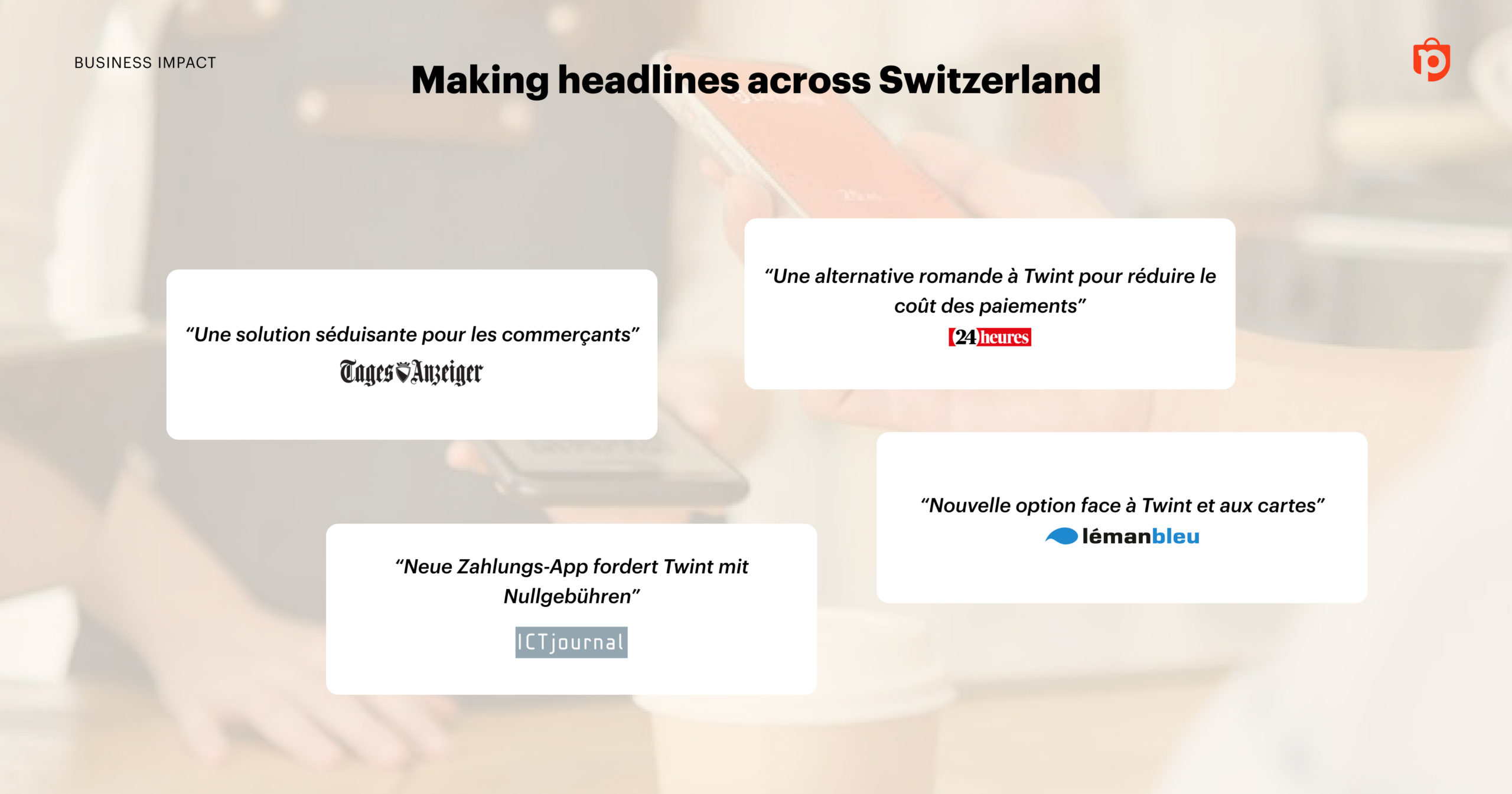
The app has been available on iOS and Android since July 2026, with the launch receiving widespread media coverage. From the very first days, adoption confirmed the market’s interest: five days after launch, more than 1,000 consumers and nearly 100 businesses had registered. Two weeks later, the figure had reached nearly 2,000. The press has already covered it extensively.
Do you have an ambitious project, demanding constraints and adoption challenges? Let’s talk about how we can help you turn it into a product.